The Underground Is Massive by Michaelangelo Matos
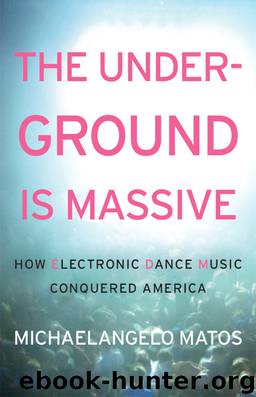
Author:Michaelangelo Matos
Language: eng
Format: epub
Publisher: HarperCollins
Published: 2015-04-07T04:00:00+00:00
I am completely prepared to allow corporate America to drop their money into our scene. I think it’s a big waste on their part that will net zero results, other to exhaust their advertising and P.R. budgets.
—MATT BONDE, MW-RAVES POST, DECEMBER 1, 1996
>12
WOODSTOCK ’99
Rome, New York
July 22–25, 1999
ON SEPTEMBER 6, 1996, MTV premiered an hour-long pilot for a new show called Amp: electronic-dance videos from all over the spectrum, from Sun Electric and Aphex Twin to Orbital and Tricky, “segued” together, DJ-style. A poster on the 313 mailing list noted that some of the show’s bumper music came from Astralwerks’ recently issued Detroit: Beyond the Third Wave compilation, including electro producer Will Web’s “Life on Tek.” Web—formerly Mr. Bill, who’d played the first Furthur—replied on-list: “Oh no. Does this mean I’ve gone commercial?”
Kidding or not, a lot of people on the lists were getting itchy that their grassroots scene could turn upside down. “The best thing we can do is guide the expansion of the rave scene into its mainstream direction with as much positive influence as possible,” an SF-Raver posted. “If we do not make our presence known, the mainstream will eventually [phase] us out completely.”
Some of the best conversation about this came from PB-CLE-Raves—the industrial Midwest had more at stake. There, parties would top out around five hundred, and they ran heavily on true belief. If the cops decided they didn’t like it, down it went, period. “I’ve heard about people getting arrested for just being at an illegal party,” posted a PB-CLE-Raver. “That really scares me, especially since if I get anything at all else on my record (besides a drinking misdemeanor), I can’t go into the military, and then I would have no idea what to do with my life.”
Still, the noise could be overwhelming, and excessively whiny, inviting well-earned derision. “Oh no!” chided a PB-CLE-Raver. “Our scene isn’t going to be ‘underground’ anymore. Uncool NORMAL people are entering our once private domain . . . Fucking grow up . . . This is starting to sound like Usenet.” On MW-Raves, Chris Sattinger was even more to the point:
Underground? Co-opted by the mainstream? All of these artists [on Amp] are fucking Europeans. These artists have been in the mainstream for years. No one makes any distinction between techno and rock as far as marketing over there. They advertise in different glossy magazines, they play venues on different nights. They have overlapping audiences. The artists remix and guest on each other’s’ albums across genres. . . . Please don’t put all of techno in the same boat. It’s been going on for twenty fucking years now. It is old enough to look after itself.
“Still,” Sattinger added in a later post, “bleeping noise and repetitive beats aren’t going to fly in Peoria.”
BY 1996, MW-RAVES HAD five hundred subscribers, SF-Raves four hundred, and NE-Raves three hundred. In this, they mirrored the rise of interactive technology. In San Francisco and Seattle, especially, Internet cafés were popping up, renting terminals at anywhere from six to ten bucks an hour.
Download
This site does not store any files on its server. We only index and link to content provided by other sites. Please contact the content providers to delete copyright contents if any and email us, we'll remove relevant links or contents immediately.
The Goal (Off-Campus #4) by Elle Kennedy(13625)
Kathy Andrews Collection by Kathy Andrews(11777)
Diary of a Player by Brad Paisley(7531)
What Does This Button Do? by Bruce Dickinson(6176)
Assassin’s Fate by Robin Hobb(6173)
Big Little Lies by Liane Moriarty(5759)
Altered Sensations by David Pantalony(5080)
Pale Blue Dot by Carl Sagan(4968)
Sticky Fingers by Joe Hagan(4156)
The Death of the Heart by Elizabeth Bowen(3589)
The Heroin Diaries by Nikki Sixx(3525)
Beneath These Shadows by Meghan March(3285)
Confessions of a Video Vixen by Karrine Steffans(3283)
How Music Works by David Byrne(3239)
The Help by Kathryn Stockett(3127)
Jam by Jam (epub)(3060)
Harry Potter 4 - Harry Potter and The Goblet of Fire by J.K.Rowling(3038)
Computational Linguistics and Intelligent Text Processing: 20th International Conference, CICLing 2019 La Rochelle, France, April 7â13, 2019 Revised Selected Papers, Part I by Alexander Gelbukh(2968)
Strange Fascination: David Bowie: The Definitive Story by David Buckley(2842)
